[ our approach ]
How we approach leadership, strategy, and change
Our role is to offer orientation in uncertain times — steady and visible, like a lighthouse. Our approach integrates foresight, strategy, culture, and vertical leadership development – and both human and artificial intelligence. It inspires new perspectives, strengthens human connection, the capacity to pause, listen, sense, and realign — enabling leaders and organisations to navigate change, co-create purpose-led strategy, and cultivate cultures of trust and renewal.
PS. We love to be outdoors for parts of our sessions. Walking, talking and breathing in natural environments lifts thinking and perspectives in ways that are hard to access within meeting rooms and offie walls.

[ our approach ]
How we go about it
Grounded in research and decades of experience, we help leaders and organisations become future-fit by strengthening inner capacity, strategic clarity, and cultural alignment.
Every organisation is a living system with its own history, dynamics, and potential. That’s why we always start by listening to you — to people, patterns, and context — whether it’s a short project or a longer partnership. Together, we design and facilitate an approach tailored to your needs. The work then evolves and adapts over time, allowing change and transformation to unfold naturally, in rhythm with your organisation’s reality.
When we can, we spend quite some time on our programs and leadership retreats outdoors, which tends to open up new and unexpected perspectives that are normally of real benefit for the team as well as their business.
[ our approach ]
Frameworks, models, and methods we utilize in our work
We draw on a thoughtfully curated blend of frameworks, models, and methods to help leaders and organisations see the wider system, understand what’s emerging, and act with clarity and coherence. Alongside well-established approaches, we also bring models we have developed ourselves — grounded in decades of practice, research, and real-world transformation work.
Our approach is never mechanical. We listen deeply to the organisation and its context, sensing where it is in its developmental and strategic journey. From there, we tailor and combine the tools that best fit the moment: sometimes providing structure and shared language, other times opening space for reflection, insight, or breakthrough thinking.
These frameworks, models, and methods serve as lenses to reveal patterns, surface deeper questions, align purpose, strategy, culture, and leadership, and expand the capacity of individuals and teams. Over time, they become shared guides that support wiser decisions, more coherent action, and organisations that are truly future-fit.
Framework examples
Leadership Evolution Map
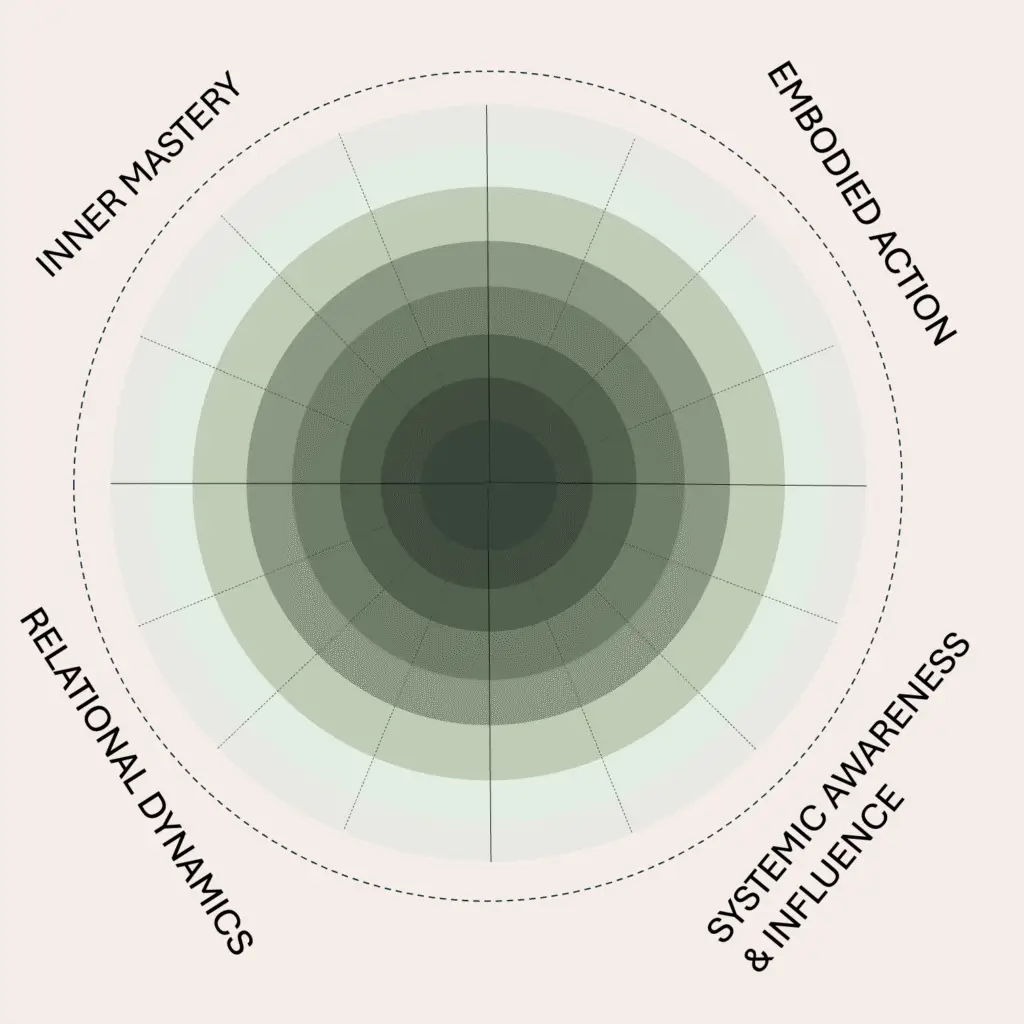
The Leadership Evolution Map offers a full-spectrum view of how leaders mature and grow in capacity.
Informed by Wilber’s AQAL model, lines of development, and the stages of Vertical Leadership Development, this model brings together four dimensions of leadership—Inner Mastery, Embodied Action, Relational Dynamics, and Systemic Awareness & Influence—and maps how each develops across key stages of vertical maturity.
The model provides a clear, practical way to understand leadership capacity and evolution. It shows how inner development, relational skill, behavioural integrity, and systemic insight evolve together into wiser, more conscious, and more transformative leadership as leaders evolve and expand their capacities.
We are currently also developing a Leadership Evolution Radar (self-assessment) as part of a PhD research project in Transformative Business Leadership.
Learn more
| Dimension | The mature leadership capacities we are supporting in your development | Description of four key mature leadership capacities across strategically selected developmental lines | ||||||||
| INNER MASTERY | Increasing self-awareness, meaning-making capacity, emotional maturity and intentional presence. |
| ||||||||
| EMBODIED ACTION | Increased capacity for self-regulation, to act consistently with your values, walking the talk, skillful action and decision making. |
| ||||||||
| RELATIONAL DYNAMICS | Increased capacity for empathic attunement, generative dialogue, trust and collaboration, and conflict and polartity navigation. |
| ||||||||
| SYSTEMIC AWARENESS & INFLUENCE | Increased capacity for systems thinking, contextual intelligence, strategic foresight and shaping systems. |
|
The Ecosystems Model: Seeing the Wider Context
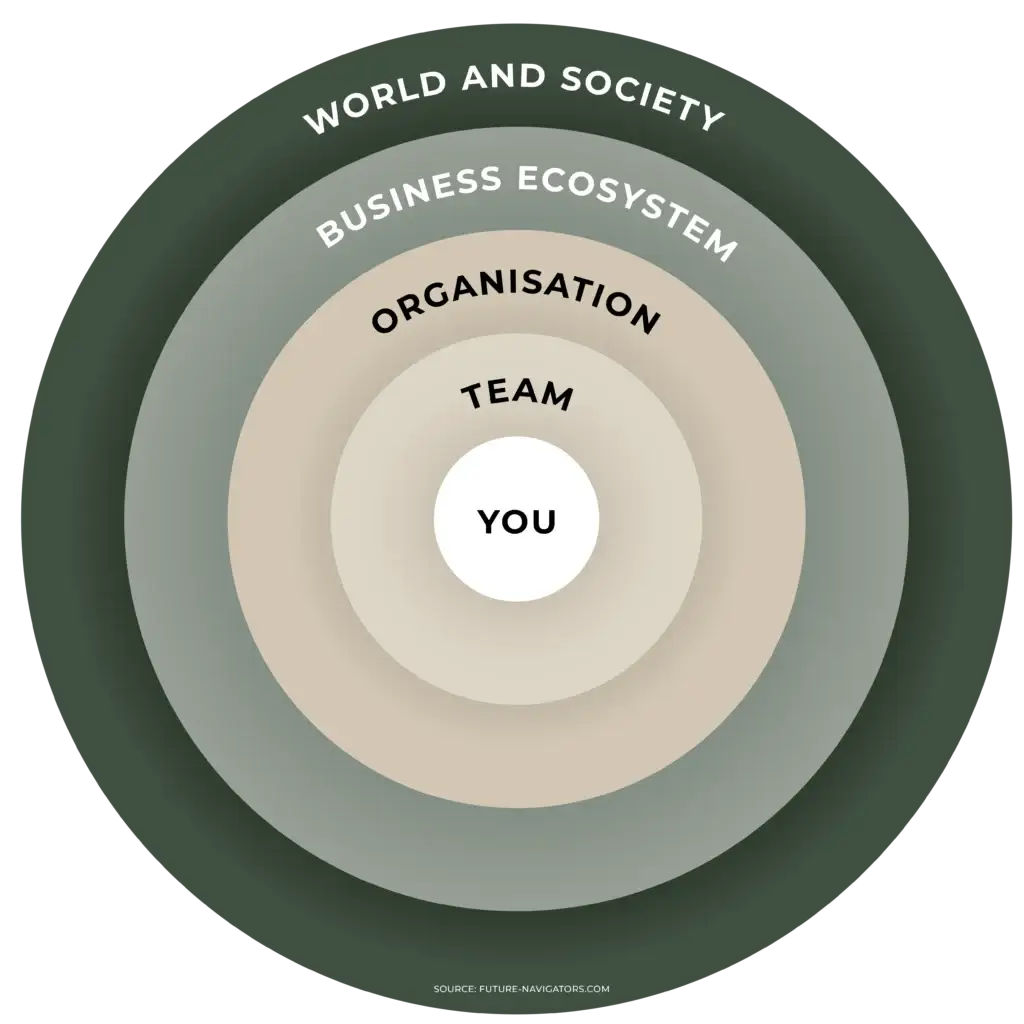
Every leader and organisation exists within a nested web of relationships — from self, to team, to organisation, to business ecosystem, and the wider world.
Each level influences the others, and lasting transformation begins when we recognise these interdependencies and lead with systemic awareness.
Coherence emerges when purpose, people, and structures align across these layers, creating conditions for vitality and renewal.
The Ecosystems Model invites leaders to explore and expand their field of vision — from the inner world of mindset and culture to the outer world of markets, communities, and planet. It offers a way to lead from connection and coherence rather than control, aligning inner development with outer impact in the service of a thriving whole.
Learn more
| Dimension | Focus | Description |
| You | Self-leadership | Cultivating awareness, purpose, and presence — the foundation for wise action and authentic influence. Transformation begins within. |
| Team | Relationships and collaboration | Building trust, psychological safety, and shared learning. A healthy team becomes a microcosm of the culture you want to create. |
| Organisation | Culture, structure and strategy | Aligning purpose, strategy, and structures to enable collective intelligence and regenerative performance. |
| Business ecosystem | Value Creation | Understanding your organisation as part of a wider living system of partners, customers, and stakeholders — where collaboration drives mutual value and innovation. |
| World and society | Systemic impact | Recognising how your organisation’s choices shape broader economic, social, and ecological outcomes — leading with responsibility for the wellbeing of people and planet. |
The Strategy Compass: Choosing the Right Strategy for Your Environment
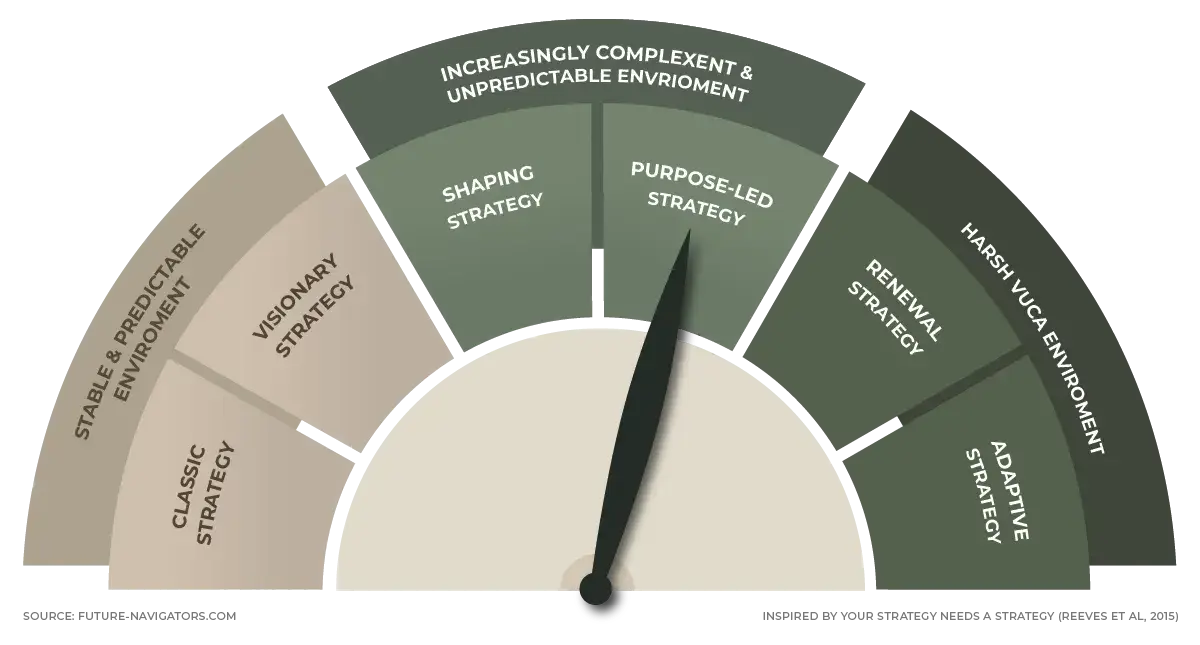
There is no single best way to formulate and execute a strategy. Instead, the effectiveness of any strategic approach depends on the nature of the environment in which a business operates.
The Strategy Compass, inspired by the book Your Strategy Needs a Strategy (2015), helps you and your team sense the nature of your context, recognise the degree of complexity and volatility they face, and choose the most fitting strategic mode — whether Classic, Visionary, Adaptive, Shaping, Purpose-Led, or Renewal. Often it is a combination of different approaches that is needed.
Learn more
| Type of strategy | When it fits | How it works |
| Classic Strategy |
|
|
| Visionary Strategy |
|
|
| Shaping Strategy |
|
|
| Purpose-led strategy |
|
|
| Renewal strategy |
|
|
| Adaptive strategy |
|
|
The Fit for Purpose Model: Aligning Context, Purpose, and Business Model
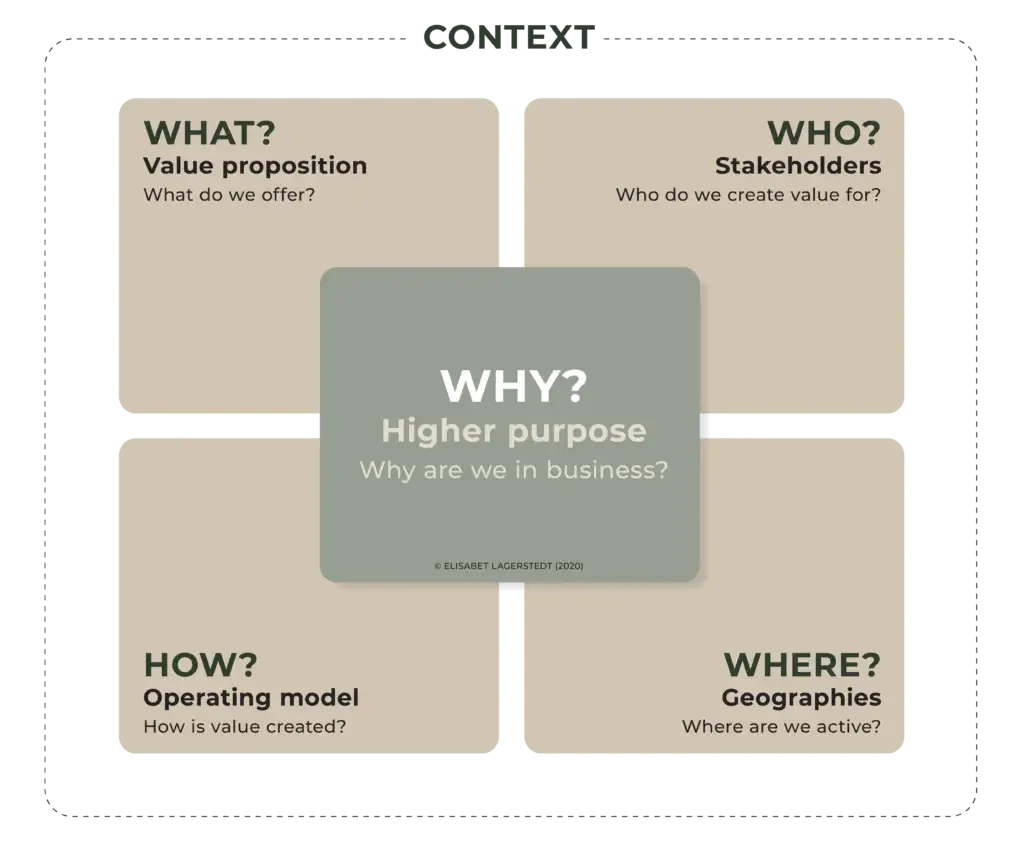
The Fit for Purpose Model provides a framework for aligning purpose, strategy, and impact in an increasingly complex world. It helps organisations connect their deeper why with what they offer, how they operate, and where they create value.
The model begins by exploring the ecosystemic context and the big problem the organisation chooses to serve. From there, six interconnected dimensions — why, what, who, where, how, and the broader context — come into alignment, bridging inner intention with outer impact. When this coherence is achieved, organisations become truly fit for purpose and for the future: integrated on the inside, responsive to the world around them, and capable of contributing meaningfully to people, planet, and future generations.
Learn more
Dimension | Focus | Description |
Ecosystemic Context | The wider system | Understanding the environmental, social, and economic ecosystems the organisation depends on — and contributes to. |
Big Problem | The call to serve | Defining the significant challenge or opportunity the organisation exists to address. |
WHY | Higher Purpose | Clarifying the reason the organisation exists beyond profit — its ultimate contribution to people, planet, and future generations. |
WHAT | Value Creation | Designing products, services, and solutions that deliver on the higher purpose and create meaningful value. |
WHO | Stakeholders | Understanding customers, employees, partners, and communities and engaging them as active participants in value creation. |
WHERE | Presence | Defining the geographic, digital, and ecosystem arenas where the organisation creates impact and learns from its context. |
HOW | Operating Model | Evolving culture, structure, and processes so the organisation’s daily operations embody its purpose in action. |
Strategic Horizons: Planning Across Futures and Uncertainty
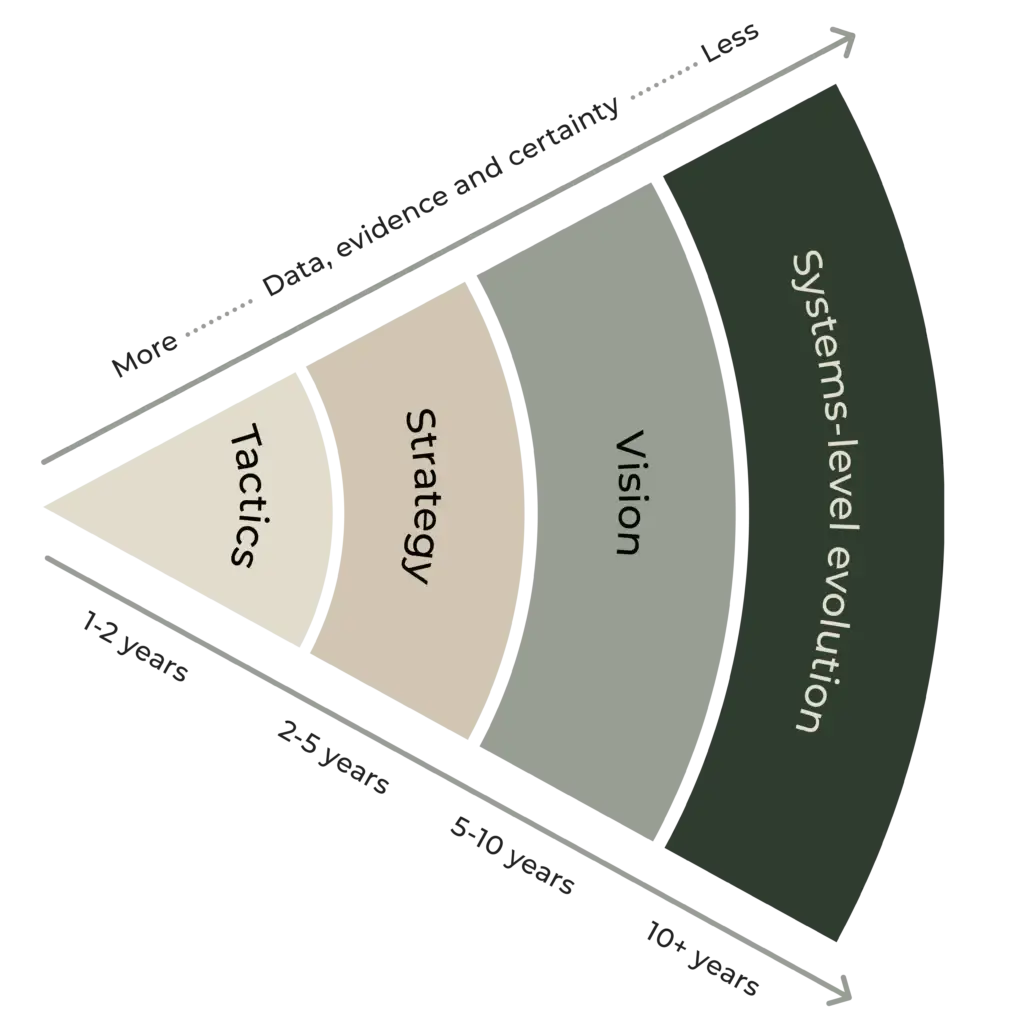
This model, developed by futurist Amy Webb, shows how leaders can think and plan across different futures as uncertainty increases.
It highlights how decision-making shifts from evidence-based optimisation in the near term to imaginative, systemic thinking as we look further ahead.
Tactics rely on strong data and fast feedback. Strategy stretches beyond immediate pressures to set direction over several years. Vision requires ambition and creativity. And at the outer edge lies systems-level evolution — where societal shifts, technological disruptions, and emerging futures reshape the context in which organisations operate.
Working across these horizons helps leaders balance execution with exploration, hold present realities alongside future possibilities, and build organisations that remain resilient and opportunity-ready in a rapidly changing world.
Learn more
| Dimension | Time | Description |
| Tactics | 12-24 months | This is the realm where you can confidently identify probable events, spot trends, and act quickly.
How to approach it:
|
| Strategy | 2-5 years | This is the familiar domain of strategic planning. Here:
How to approach it:
|
| Vision | 5-10 years | Here, uncertainty is high and leaders must imagine possible futures beyond what data alone can reveal. This is not about prediction but direction-setting: articulating a future state that guides strategy and inspires long-term capability building. Here:
How to approach it:
|
| Systems-level evolution | 10+ years | This is the widest part of the time cone — where probability is lowest, but long-term orientation is most critical. Here:
How to approach it:
|
The Futures Triangle: Understanding the Past, Present and Future, and their Interconnections
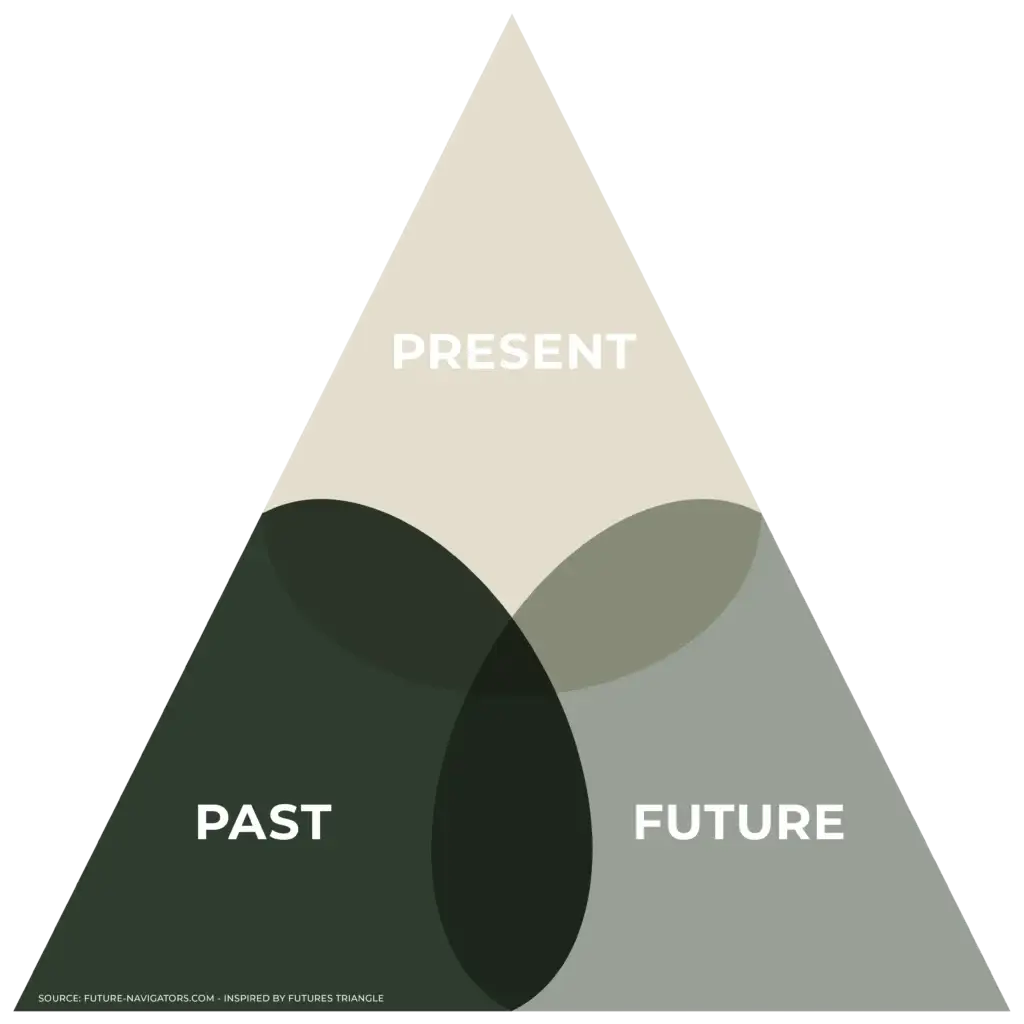
Every organisation — like every leader — exists within a living flow of time: past, present and future.
The past holds the stories, structures, and choices that shaped who we have become. The present is the meeting point of awareness and action — where patterns can be seen, decisions made, and possibilities opened. The future calls us forward with imagination, purpose, and responsibility.
These three forces are always in motion: the weight of the past, the push of the present, and the pull of the future. Wise leadership integrates them all — learning from experience without being constrained by it, acting with clarity in the moment, and sensing into futures worth creating.
When leaders consciously hold this temporal field, they expand their perspective. They begin to see that what we call “strategy” is not just about planning ahead — it is about cultivating presence, learning from history, and taking moral responsibility for what comes next.
Learn more
| Dimension | Focus | Description |
| Past | Legacy and learning | Understanding the experiences, patterns, and decisions that shaped today’s reality — and discerning what to carry forward or release. |
| Present | Awareness and alignment | Seeing clearly what is — the current context, relationships, and dynamics — and aligning intention with conscious action. |
| Future | Possibility and foresight | Exploring megatrends, imagining desirable futures, and creating pathways that link long-term vision to today’s choices. |
Inner Development: Expanding the Inner Capacity to Lead and Thrive in a VUCA World
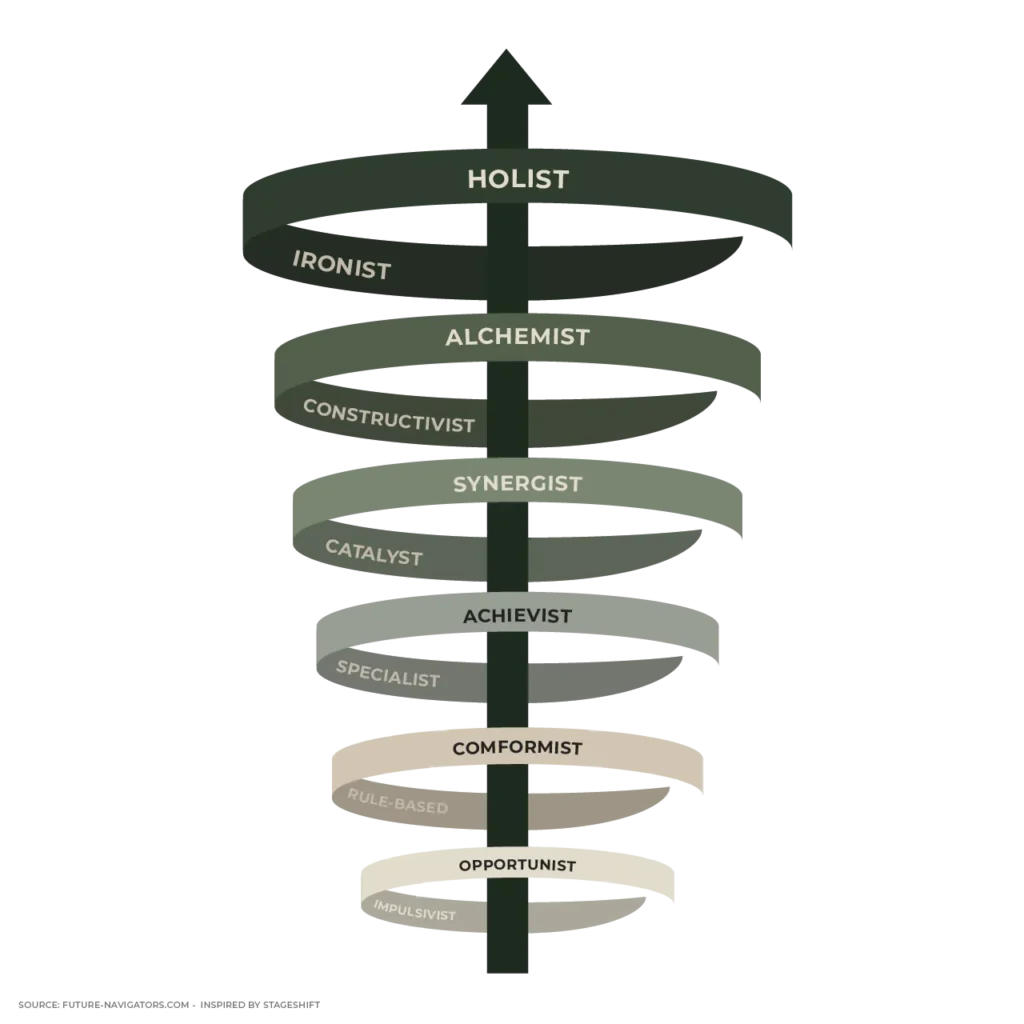
Inner development aims at the long-term expansion of a leader’s inner capacity.
Our approach goes beyond strengthening skills, to upgrades the deeper operating system that shapes how leaders think, relate, decide, and act.
As leaders grow through stages of ego-maturity, they develop greater perspective-taking, emotional regulation, systemic awareness, and the ability to hold paradox and uncertainty with clarity.
This takes time. But, it’s worth it. When leaders expand their inner architecture, they make wiser decisions, navigate disruption with more coherence, and create organisations that are adaptive, purpose-driven, and better prepared for the future.
Learn more
Leadership Capacity | Description |
Perspective & Meaning-Making | How leaders interpret reality and make sense of complexity.
Why it matters: Leaders can respond more wisely when they perceive more of the system and understand challenges through a broader, more nuanced frame. |
Self-Leadership & Inner Capacity | How leaders regulate their inner world under pressure.
Why it matters: Inner regulation enables leaders to stay clear, calm, and intentional — even when conditions are turbulent — rather than amplifying stress in the system. |
| Relational & Social Capacity | How leaders connect, collaborate, and influence others.
Why it matters: As organisations become more networked and interdependent, leadership depends on trust, collaboration, and the ability to empower rather than control. |
| Systems Thinking & Impact Orientation | How leaders understand and shape the larger systems they operate in.
Why it matters: Leaders at later stages anticipate ripple effects, design for long-term value, and contribute to healthier ecosystems rather than reinforcing short-term, siloed patterns. |
| Decision-Making & Judgment | How leaders make choices in complexity.
Why it matters: Leaders must expand their “decision-making bandwidth” as complexity increases. |
| Purpose & Values Orientation | What anchors and motivates a leader.
Why it matters: Purpose becomes a stabilising force in uncertain environments. |
| Learning & Adaptability | How leaders relate to change and personal growth.
Why it matters: Vertical development depends on the ability to unlearn and evolve. |
| Time Horizon & Temporal Awareness | How leaders relate to past, present, and future.
Why it matters: Mature leaders hold multiple time horizons simultaneously — essential for shaping rather than reacting. |
| Impact Orientation & Social Responsibility | How leaders understand the consequences of their actions across systems.
Why it matters: As leaders mature, they widen their sense of responsibility and see themselves as part of a larger whole. |
| Creative & Innovative Capacity | How leaders generate new possibilities.
Why it matters: Innovation shifts from improvement → reinvention → emergence. |
| Ethical & Moral Reasoning | How leaders navigate dilemmas, competing values, and the long-term consequences of their choices.
Why it matters: In a world of systemic challenges, leaders must make decisions that are not only effective but responsible, conscious, and aligned with long-term societal wellbeing. |
| Embodiment & Presence | How leaders use their physical, emotional, and intuitive awareness to stay grounded and connected.
Why it matters: Presence is contagious. Leaders who are centred and embodied regulate not only themselves but also their teams and organisations — enabling healthier cultures and clearer decision-making. |
The Barrett Values Model: Understanding the Values that Shape Behaviour and Culture
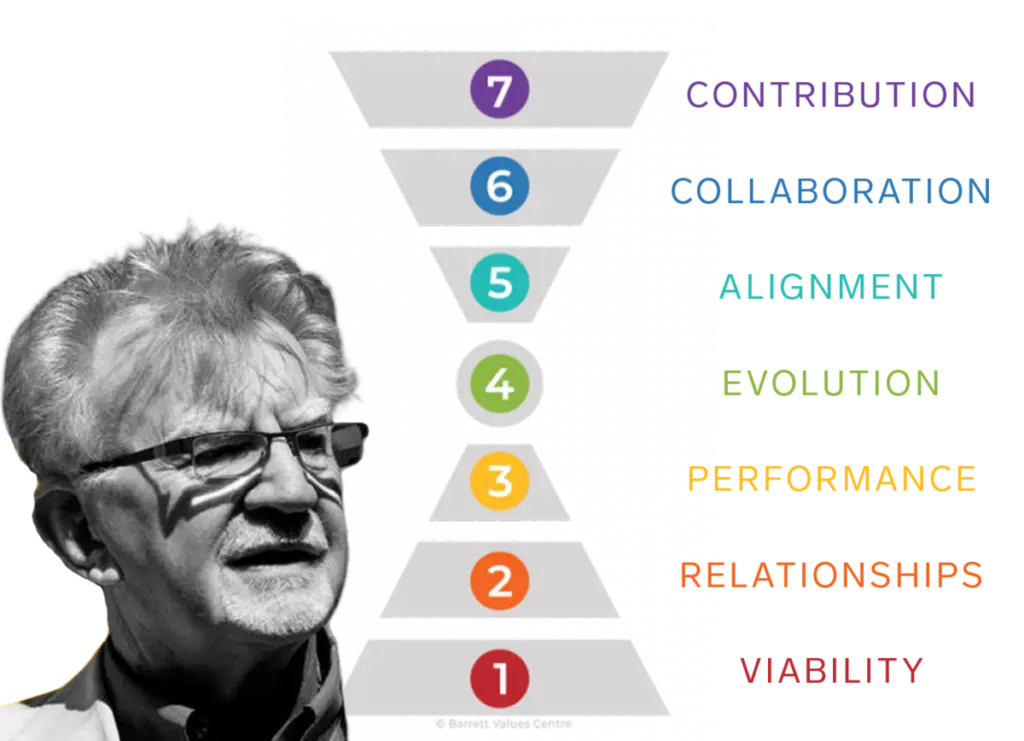
This model, developed by Richard Barrett, helps leaders understand the deeper motivations shaping behaviour in individuals, teams, and organisations.
It maps values across seven levels of consciousness — from basic survival needs to purpose-driven contribution — revealing what drives decisions and culture.
By comparing personal and collective values, the model highlights cultural strengths, uncovers limiting beliefs, and shows where misalignment may hinder performance or transformation.
We are certified and use the Barrett model for assessments and full-system transformations to help leaders and organisations build greater coherence and authenticity, creating cultures that support engagement, learning, and sustainable, values-aligned change.
Learn more
| Level of Consiousness | Description |
| 1. Viability | Focus: Safety, stability, basic needs. Motivations: Security, health, financial stability, predictability. Leadership & culture: Clear structure, risk avoidance, attention to fundamentals. When overemphasised, fear and control dominate. |
2. Relationships
| Focus: Belonging, trust, connection. Motivations: Positive relationships, respect, open communication. Leadership & culture: Collaboration grows; people feel valued and included. When unmet, conflict, blame, or people-pleasing can appear. |
| 3. Performance | Focus: Achievement, confidence, strong performance. Motivations: Results, quality, professionalism, competence. Leadership & culture: High standards and accountability. When unbalanced, can drift into status, ego, or competition. |
| 4. Evolution | Focus: Growth, learning, openness to change. Motivations: Adaptability, curiosity, empowerment, self-awareness. Leadership & culture: Continuous improvement and agility. Leaders model reflection and learning; people feel safe to experiment. |
| 5. Alignment | Focus: Purpose, values, alignment. Motivations: Integrity, authenticity, clarity of direction, meaning. Leadership & culture: Purpose-led decision-making; strong alignment between values and actions. Creates deep trust and coherence. |
| 6. Collaboration | Focus: Impact beyond the organisation. Motivations: Service, collaboration, shared success with stakeholders. Leadership & culture: Commitment to long-term value creation; partnership and contribution become central. |
| 7. Contribution | Focus: Societal and planetary wellbeing. Motivations: Compassion, humility, global responsibility, legacy. Leadership & culture: Regenerative, future-focused, and deeply ethical. Leaders act for the benefit of current and future generations. |
Immunity to Change: Building Capacity for Change
The Immunity to Change framework, developed by Robert Kegan and Lisa Lahey, reveals the hidden beliefs and protective patterns that keep leaders stuck — even when they are genuinely committed to change.
It helps uncover the “internal immune system” that unconsciously blocks new behaviours, often out of fear, identity protection, or competing commitments.
By making these underlying assumptions visible, leaders can shift from surface-level change to deeper transformation. The method offers a structured way to explore what you want to change, what you’re doing that prevents progress, and the invisible commitments that hold old patterns in place.
We are trained in the method by Robert Kegan and use it to help leaders and leadership teams expand their self-awareness, dissolve long-standing barriers, and unlock new ways of leading that are more aligned, intentional, and effective in complexity.
Learn more
| Map component | Description |
| Improvement Goal | What it represents: A meaningful personal goal that would make you more effective as a leader. It should be something you genuinely want to change. Why it matters: Clarifies the developmental edge you are trying to grow into and sets the focus for the whole map. |
Behaviours that work against my goals
| What it represents: The specific actions — often unconscious — that undermine your stated goal. These are not “bad behaviors” but self-protective patterns. Why it matters: Reveals the internal contradictions between what you want and what you actually do, highlighting the real barrier to change. |
| Hidden, competing commitments | What it represents: The fears, worries, and protective commitments that keep the unhelpful behaviors in place. These commitments often serve emotional or psychological safety. Why it matters: Shows the “immune system” at work: the inner logic that protects you from perceived risk, even when it limits growth. |
| Big assumptions | What it represents: The deep beliefs or mental models that make the competing commitments feel necessary. These assumptions are often unquestioned and taken as truth. Why it matters: Identifies the root cause of the immunity. Once surfaced, these assumptions can be tested and transformed, unlocking real change. |
Other inspirational resources
Be inspired by some of the other sources, methods and approaches we apply in our projects – from Immunity to Change, to Theory U, and StageSHIFT Coaching, to Systems Innovation, and Impact Business Models.
Immunity to Change
This Harvard-based framework and method help individuals reveal the unconscious assumptions and protective patterns shaping their mindset. It enables leaders to surface hidden barriers, open new pathways for action, and more fully embrace the personal and organisational changes they seek.
Theory U
Theory U provides an awareness-based model and method for changing systems, blending systems thinking, innovation, and leading change from the viewpoint of an evolving human consciousness. It guides leaders through a disciplined process of sensing, presencing, and realising emerging future possibilities.
StageShift Coaching
StageSHIFT Coaching is a highly innovative and integrative approach to adult and leadership development that liberates the mind, spirit, and heart to realize our unlimited human potential. The approach has proven to be four times more effective in 10 percent of the time invested than other vertical leadership development methods.
Barret Values Center
These tools and methods help align strategy, leadership, and culture by creating coherence between what the organisation aspires to be and how it actually operates. They enable you to measure and understand your current values and culture, and to co-create a future culture that meaningfully supports your desired direction and long-term success.
Inner Development Goals
The Inner Development Goals (IDG) began with the insight that achieving the SDGs requires inner human capacities and skills as much as technical solutions. It has since become a global movement, offering an updated IDG Guide with practical tools for developing awareness, empathy, collaboration, and systems thinking to tackle complex challenges.
Polarity Mapping
Polarity Mapping helps leaders work wisely with tensions that can’t be solved, only balanced — such as stability and change or autonomy and alignment. By making these dynamics visible, it helps teams avoid either–or thinking, recognise early warning signs, and design actions that honour both sides. This leads to more resilient decisions.
Stanford d.school
Stanford d.School is a place for explorers, innovators and experimenters at Stanford University. The d.school helps people develop their creative abilities. It is a community and a mindset to help people unlock creative abilities and apply them to the world. Be inspired by their website.
Cynefin Framework
The Cynefin Framework was developed to help leaders understand their challenges and to make decisions in context. It recognises that our actions need to match the reality we find ourselves in through a process of sense-making.
Three Horizons Framework
The Three Horizons Framework, helps leaders see change through three lenses: what is declining, what is emerging, and what could define the future. It supports working simultaneously on today’s performance, next-generation innovations, and long-term transformational possibilities.
Stanford Impact Business Model Canvas
The Impact Business Model Canvas is a framework for visualising, evaluating, and refining your business model to achieve both social and financial value. It helps organisations clarify how their activities create positive impact, strengthen alignment with purpose, and identify opportunities to enhance their contribution to society.
System Innovation Network
The Si Network is an online platform connecting people around the world to learn and apply the ideas and methods of systems innovation towards addressing complex challenges and building better systems that work for all.
Strategizer Unpacks Innovation
Ideas, learnings and methods to help you further your understanding and practice of innovation. The team behind the books Business Model Generation, Value Proposition Design, Invincible Companies, Testing Business Models, and more.
Ideo.org
IDEO is the leading innovation and design firm in the world. IDEO.org is their nonprofit design studio. They design products and services for organizations committed to creating a more just and inclusive world. Be inspired by innovation doing good.
Design kit by ideo.org
Design Kit is IDEO.org’s platform to learn human-centered design, a creative approach to solving the world’s most difficult problems. Their mission is to help you routinely innovate and solve big problems
Service Design Network
The Service Design Network (SDN) is the leading non-profit institution for expertise in service design and a driver of global growth, development and innovation within the practice.
Circo Circular Design
The circular economy does not arise by itself. CIRCO activates entrepreneurs and creative professionals to (re) design products, services and business models in order to subsequently do circular business.
Ten Types of Innovation
Creating new products is only one way to innovate. The Ten Types of Innovation-framework provides a way to identify new opportunities beyond products and develop viable innovations.
Blue Ocean Strategy
BLUE OCEAN STRATEGY is the simultaneous pursuit of differentiation and low cost to open up a new market space and create new demand. It is about creating and capturing uncontested market space, thereby making the competition irrelevant.