




Every meaningful strategic journey begins long before we start shaping purpose statements or describing who we want to become. It begins by widening our field of vision — from past, to present, and to the evolving future — to understand the deeper story and context that the organisation is part of.
In any strategy review, looking honestly at where the organization comes from — what has enabled its success, what has limited its potential, what has been forgotten, and what deserves to be carried forward — is essential. Without discerning what to bring with you and what to let go of, we risk carrying unnecessary weight and barriers into the future.
From there, we turn our attention to the present, which is rarely static. Today, it’s a landscape defined by VUCA (volatility, uncertainty, complexity and ambiguity) and accelerating change with shifting technologies, ecosystems, geopolitical tensions, social expectations, regulations, cultural movements, and economic undercurrents. It is not static, it’s dynamic.
Hence, “the present” is not only what can be seen and measured; it is also the felt sense of what is emerging — the subtle signals that reveal deeper patterns of change. This is what we refer to as context. And sensing context is not merely analysis — it is attunement. But even this is not enough.
Look beyond the horizon
To understand how to stay relevant, credible, and attractive going forward, leaders must also be willing to look beyond the horizon of the present and engage with the emerging futures. This is where foresight, megatrends, scenarios, and future sensing enter the strategic arc.
Foresight is not about prediction, but about what is possible and plausible. It is a disciplined curiosity: a capacity to explore how the world is shifting and what these shifts might demand of us. Foresight helps us explore alternative futures so they can make wiser choices in the present. It expands strategic creativity and imagination. It also reveals risks and opportunities that linear models miss.
It also invites us to explore the question: what will it take for us to remain meaningfully relevant to our ecosystem in the unfolding future? What might our role be? How might we create value for all stakeholders?
A higher purpose as an integrating force
Only when we have engaged with the past, sensed the present, and explored possible and plausible futures can we begin the deeper work of reviewing our higher purpose — the enduring contribution the organisation chooses to make.
A higher purpose does not arise in isolation. It is shaped by:
- where we come from (our story),
- where we stand (our present context),
- where we want to go (the emerging future landscape).
Does our current purpose stand the test of time? Is it still relevant? If not, it needs a revisit to become the integrating force — the inner orientation that holds these temporal lenses together. In a VUCA world of accelerating change it needs to become the stable center — an anchor that stabilises us in the winds of change.
From that higher purpose, vision emerges more naturally. From vision, mission takes shape. From mission, strategy reveals the identity the organization must grow into. Strategy, in this way, is not only a set of decisions. It is an arc of becoming. It describes how the organization will transform itself in order to contribute meaningfully to the future it envisions.
Strategy becomes the evolutionary response to the tensions between who the organization has been, who it is now, and who it is called to become. Yet strategy alone cannot move an organization.
This is where strategy activation and mobilisation comes in — the deeply human space where purpose, foresight, and strategy become embodied in culture, capabilities, structure, and action.
Strategy needs activation and mobilisation
It is in this space of activation and mobilisation that organisations align their structures and processes, translate strategy into team-level meaning, build the right capacities, cultivate psychological safety, and run early experiments that generate learning, confidence, and momentum.
Activation is where strategy becomes lived experience. It is the bridge between intention and reality. And when activation flows into action and learning, a living system emerges — one that is always evolving, always sensing, always becoming more attuned to both internal and external realities.
Strategy as a rhythm across time – aligning inner and outer worlds
What we ultimately see is that strategy is not a moment in time. It is a rhythm across time. And so, strategy becomes a dynamic cycle of sensemaking and integration. A practice of aligning inner and outer worlds, and a way of leading consciously in complexity.
When leaders embrace this fuller arc the organization gains not only direction, but depth. Not only coherence, but wisdom. Not only plans, but the capacity to respond with clarity, courage, and integrity as the future unfolds.
This is what we believe that mature strategy development in a VUCA world needs.
Does it sound fluffy? It doesn’t have to.
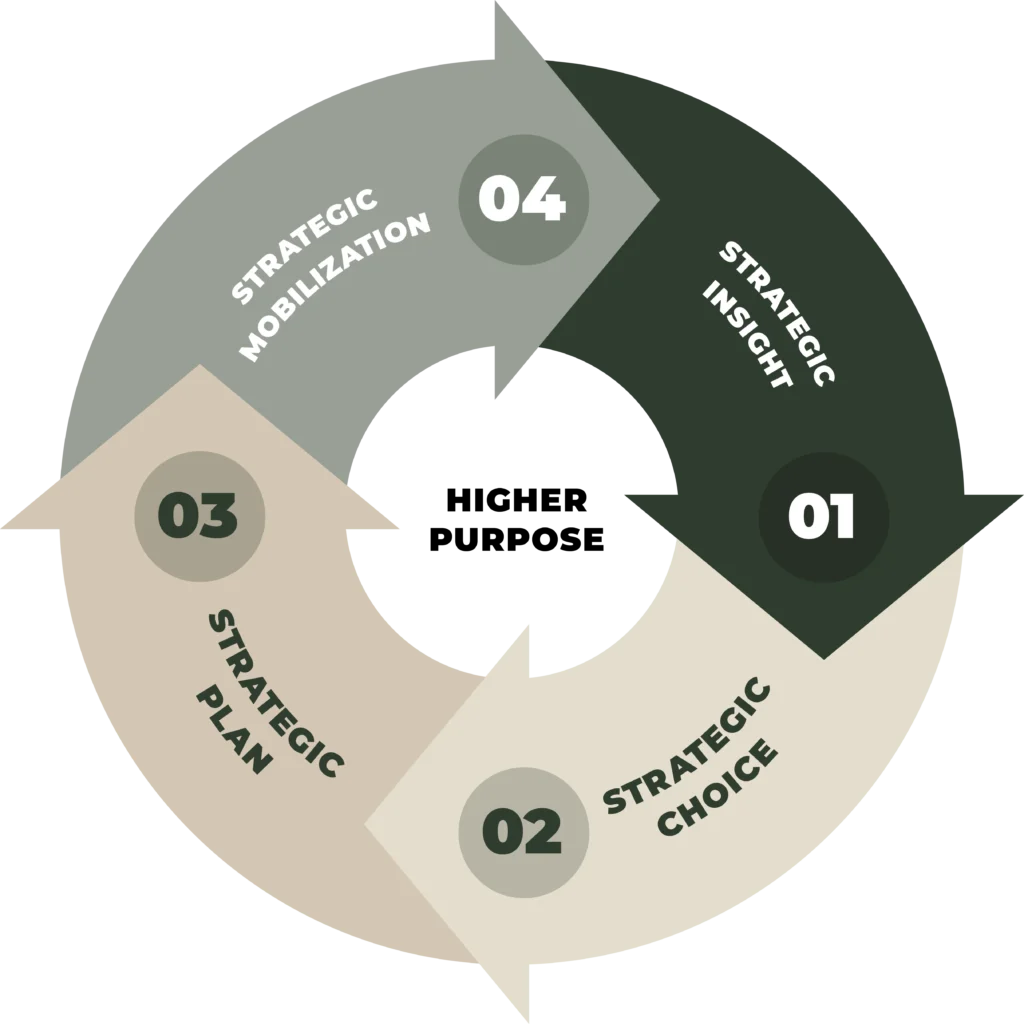
We have translated it to this simplified arc in our work with clients — from strategic insight, to strategic choice, to strategic plan, to strategic mobilisation. See image below.
Get in touch if you want to learn more about how we can help you, your leadership team and your next strategy become future-fit.